- Role
- End-to-end delivery
- Platform
- Shopify Admin API
- Year
- 2026
- Focus
- CLI / Custom data / Version control
Overview
This project was built to solve a gap in how Shopify teams manage Metaobjects and Metafield definitions. These primitives power headless storefronts, navigation systems, and merchant-specific content models — but Shopify Admin offers no native way to treat them like code: review changes in git, detect drift between environments, or promote schema safely from development to production.
The solution combines schema-first export/import, stable cross-store identity mapping, and read-only drift detection in a monorepo spanning a companion Shopify app (OAuth and session handling) and a publishable CLI. Together they give agencies and engineering teams a repeatable workflow for custom data — from local development through multi-store migration — without manual GID reconciliation in Admin.
Technical Highlights
The platform combines declarative schema management, registry-based identity remapping, and dependency-aware graph processing in a single toolchain. Architecture and implementation were kept aligned: schema is version-controlled, migration data stays separate, and every import path respects reference graphs so the system stays reliable as models grow.
Architecture
The core challenge was that Shopify custom data is shop-scoped and graph-shaped. Every metaobject carries environment-specific GIDs, definitions reference other definitions through validations, and instances reference each other in ways that break naive bulk import.
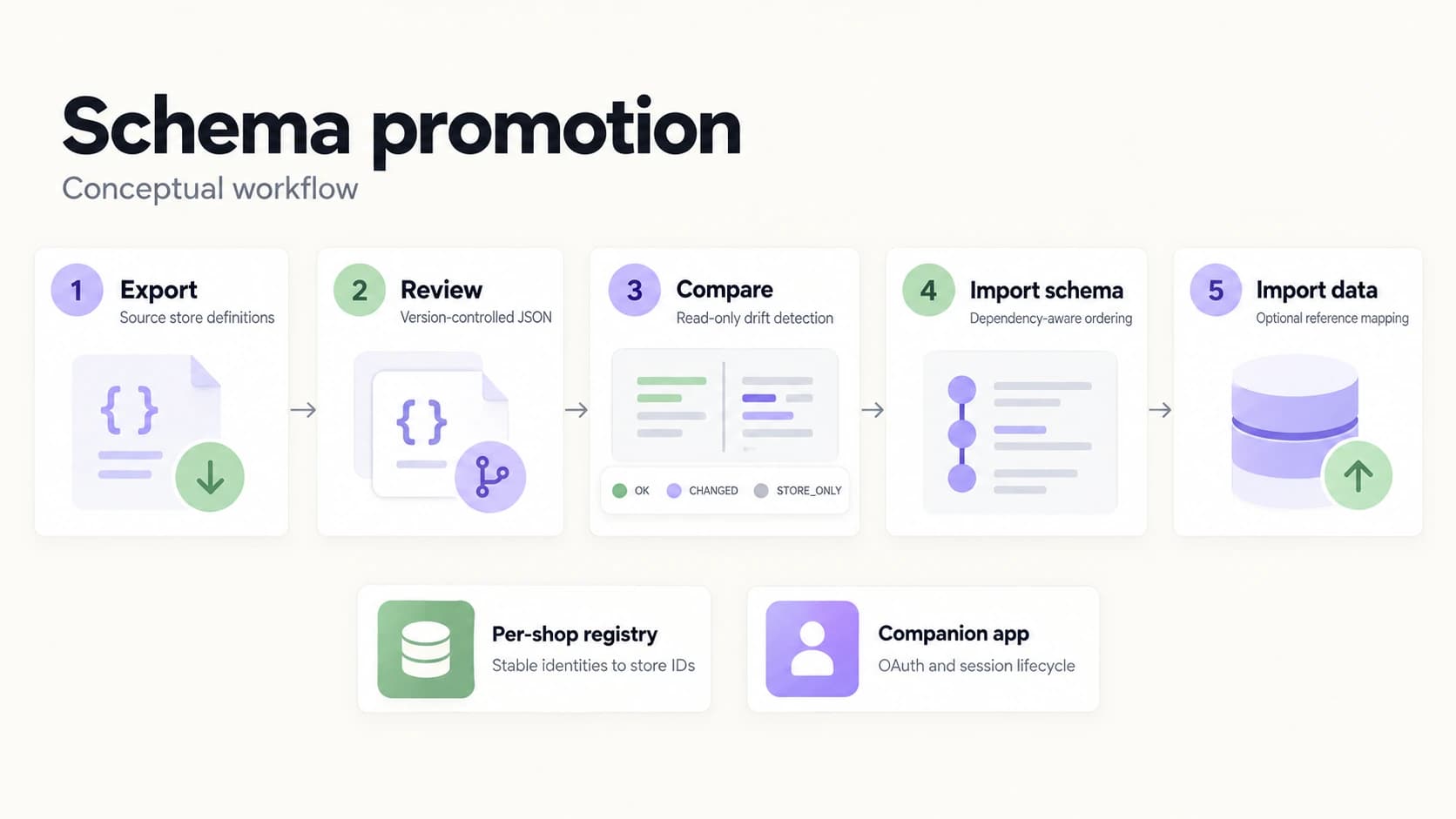
The platform uses a two-layer model: human-readable JSON on disk backed by registry files that translate stable identities to live Admin API identifiers per shop. Import pipelines build dependency graphs from schema validations and instance field references, then process nodes in topological order. Cross-shop migration deliberately strips non-portable references (products, pages, media) while preserving metaobject-to-metaobject relationships — making content model promotion predictable without requiring broad Admin scopes.
End-to-end delivery includes the Shopify app (OAuth, CLI login flow, webhook lifecycle), the CLI (export, import, diff for metaobjects and metafields), local token management, and GitHub Packages publishing — so the toolchain ships as a product teams can install into any workspace.
Schema Promotion & Drift Detection
The platform treats custom data schema as infrastructure, not store configuration edited by hand.
Export commands pull live definitions into normalized, stable JSON under shopkit/exports/. Teams commit schema changes to version control and run diff commands against target stores before promotion — surfacing drift (OK, CHANGED, STORE_ONLY) without mutating production. Import applies schema first, then data, using per-shop registries under shopkit/imports/<shop>/ so multiple target environments can be managed from a single export without registry collisions.
Metafield definitions follow the same pattern, with owner-type scoping and registry remapping when validations reference metaobject types — keeping schema comparisons accurate across shops. Diff, import, and export share the same scoping rules (--type, dependency closure, --no-deps) so behavior is consistent across the full lifecycle.
Outcome
The result is a developer-grade workflow for Shopify custom data that turns Metaobjects and Metafields from admin-only artifacts into version-controlled, promotable infrastructure.
By connecting git-backed schema management, multi-store registry mapping, and dependency-safe migration, the system reduces manual Admin work, lowers the risk of broken reference graphs during store launches, and provides a foundation for CI-driven schema checks and repeatable environment promotion — delivered as a shippable CLI and companion app, not a design-only proposal.