- Role
- Solution Architect
- Platform
- Shopify POS
- Year
- 2026
- Focus
- Analytics / Attribution / Events
Overview
Retail teams invest heavily in merchandising and product placement, yet measuring the impact of those decisions is often difficult.
This project was designed to bridge that gap by providing a Shopify POS platform for tracking product placements and attributing sales to physical store displays. By combining placement history with order and refund events, the system delivers accurate, wall-level performance insights across multiple retail locations.
Technical Highlights
The platform was built around three core principles: historical accuracy, scalability, and operational simplicity.
Product movements are tracked through a complete placement history, allowing sales to be attributed to the correct wall at the time of purchase. Store-specific configurations support multi-location deployments, while idempotent webhook processing ensures reliable order and refund attribution.
The underlying data model was designed for analytics from day one, enabling reporting across walls, products, variants, stores, and time periods.
Architecture
The core challenge was maintaining accurate sales attribution as products moved between displays throughout the day.
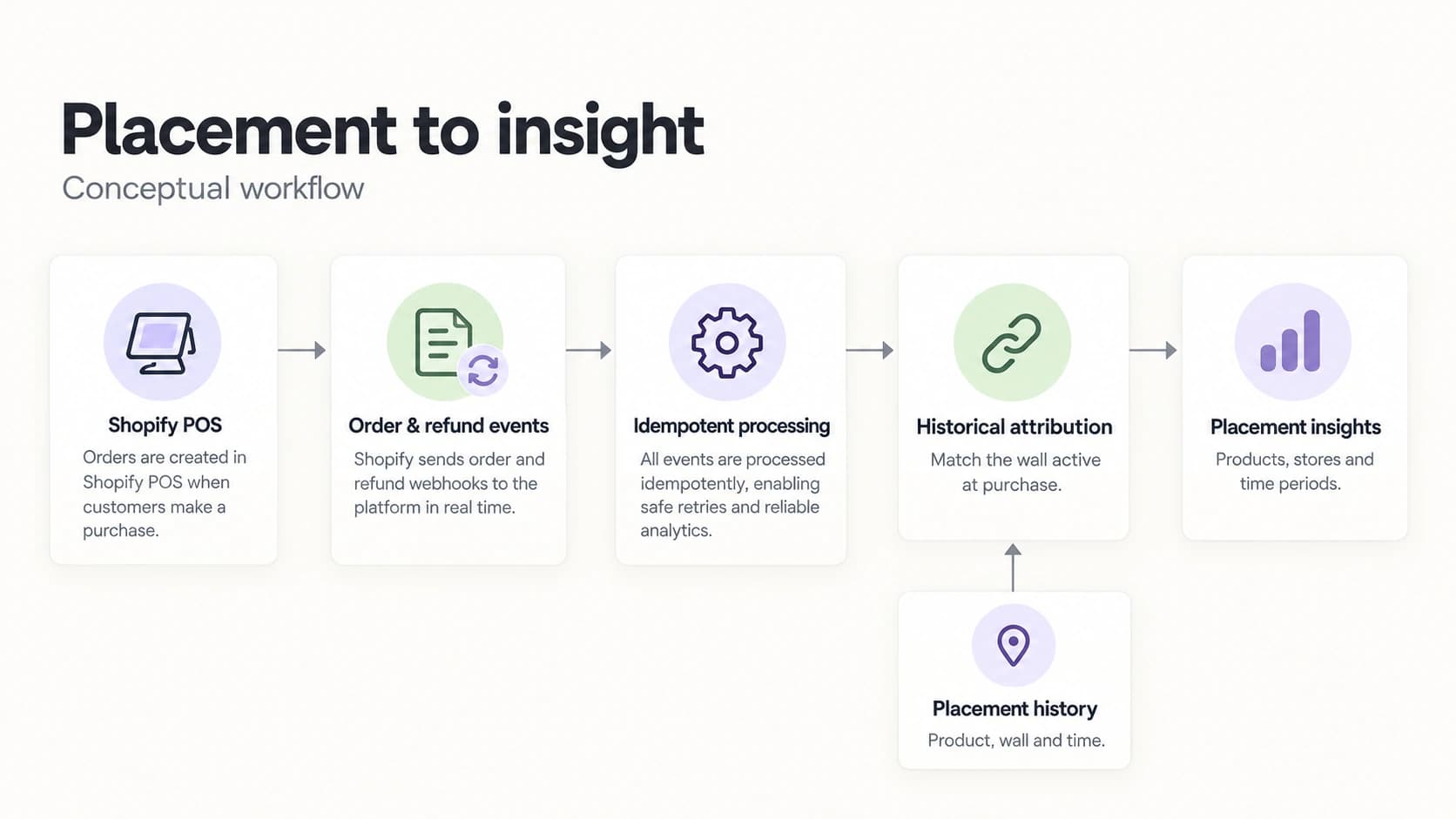
To solve this, the platform stores a complete placement history for every variant. When a sale occurs, the attribution engine resolves the product against the wall that was active at the exact time of purchase, ensuring reporting remains historically accurate regardless of future movements.
Webhook Processing
Sales attribution is powered by Shopify order and refund webhooks.
When an order is created, each line item is matched against the placement history that was active at the time of purchase. Refunds follow the same approach, linking back to the original attribution record to ensure reporting remains accurate.
To maintain reliability, all processing is idempotent, allowing events to be safely retried without creating duplicate analytics records.
Outcome
The result is a scalable analytics platform capable of transforming shop-floor activity into actionable merchandising insights.
Through historical attribution, event-driven processing, and an analytics-first data model, the system enables reliable reporting across walls, products, variants, and stores while providing a foundation for future data-driven merchandising initiatives.