- Role
- Architecture & Implementation
- Platform
- Shopify Theme
- Year
- 2025
- Focus
- Web components / Stories
Overview
Retail discovery on mobile is increasingly story-driven, yet standard e-commerce layouts struggle to deliver the same immersive, sequential browsing experience consumers expect from social platforms. The business needed a native storefront format that could surface editorial content, brand campaigns, and sport-specific collections without pulling users out of the purchase journey.
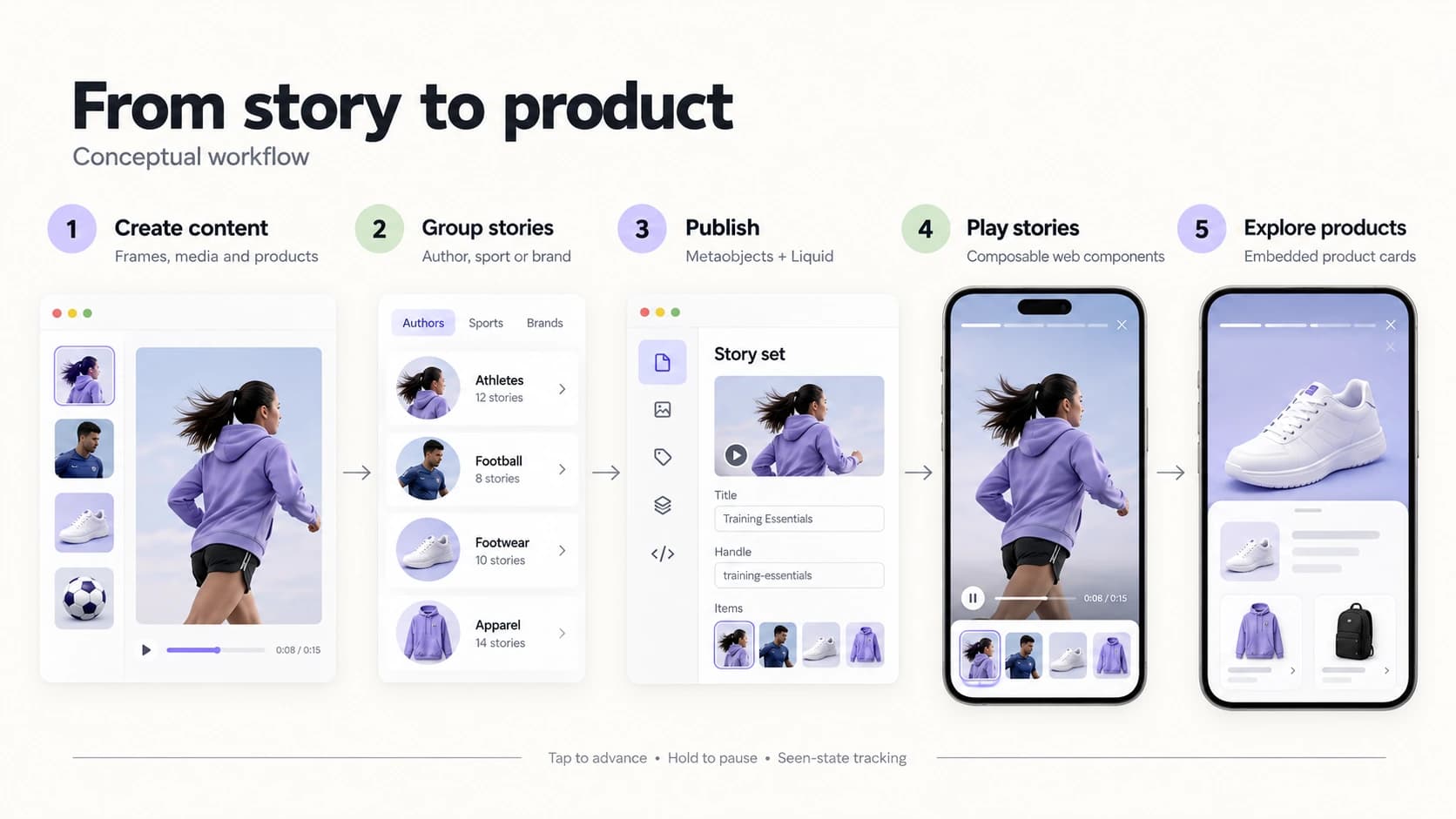
Starting from a basic story playback concept, the platform was evolved into a full commerce storytelling system. By combining familiar story navigation, author-based grouping for sport verticals and brands, and embedded product cards within frames, the experience turns passive browsing into direct commerce — designed, architected, and built end-to-end as a composable component system within the Shopify theme.
Technical Highlights
The platform combines composable web components, event-driven orchestration, and metaobject-backed content to deliver a scalable and reliable solution. The architecture was designed to support placement across the storefront while keeping playback behaviour consistent regardless of where stories are embedded.
Architecture
The core challenge was replicating a mobile-native, fullscreen story experience inside a Shopify theme — a server-rendered, section-based environment where components mount and unmount dynamically during theme editor and section updates.
The implementation architecture uses a tree of Lit web components orchestrated through bubbling custom events. A root controller manages which story set is active and coordinates navigation between sets; each set owns its trigger, portal, and frame content. The portal renders into document.body via a modal layer, isolating the fullscreen viewer from surrounding layout constraints. Content is modelled as Shopify metaobjects — story sets with ordered frames, optional product collections, thumbnails, and author metadata — with Liquid composing static markup and the client components owning all interaction and timing.
Several product concepts were introduced during implementation to extend the original scope: author identity for editorial grouping, collection frames as a shoppable end-cap to each story, and seen/unseen ring state tied to local view persistence. These evolved the basic story viewer into a merchandising channel the content team could operate independently.
Playback & Interaction
The platform relies on an event-driven interaction model for all story lifecycle transitions — open, close, complete, and cross-set navigation.
The frames engine handles autoplay with segmented progress bars, supporting both timed image frames and multi-loop video playback. Tap zones advance or rewind; a hold gesture pauses progress without interfering with product link clicks. Collection frames are treated as a distinct frame type — autoplay suppressed, progress immediately complete, user free to browse the embedded product grid. When a story completes, events propagate upward to advance to the next author set or close the viewer, preserving a continuous feed experience across sport categories and brand channels.
Outcome
The result is a scalable commerce storytelling platform that provides immersive, shoppable content discovery directly within the storefront.
By connecting familiar story UX patterns, author-based content organisation, and in-frame product cards, the system delivers editorial engagement while shortening the path to purchase. The composable architecture — designed and implemented as a cohesive component system — provides a foundation for future expansion without reworking the core playback or orchestration layers.